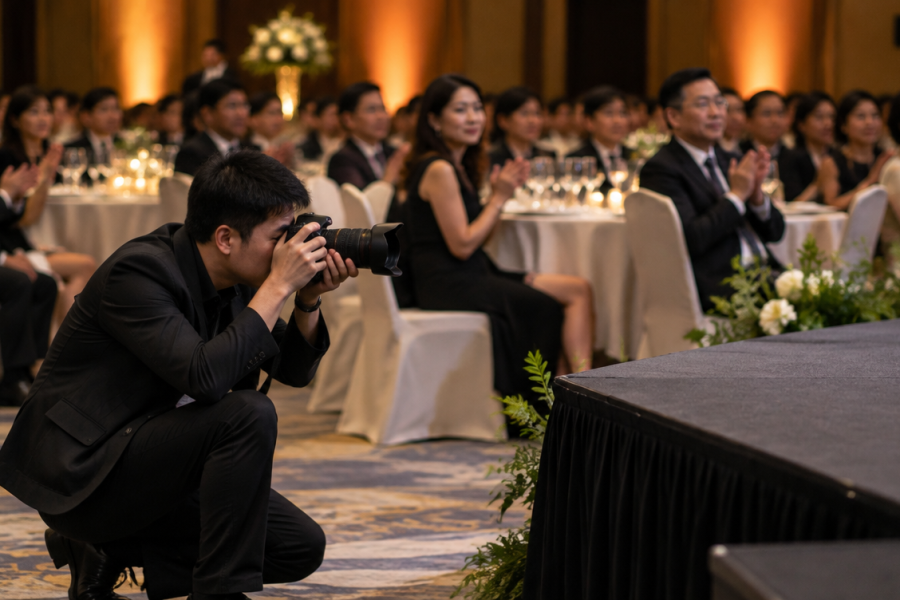
Six forty in the evening, the ballroom doors are minutes from opening, and the AV crew is still testing the stage microphones. Your photographer arrives, shakes your hand and asks one entirely reasonable question: what time is the CEO doing her walkabout? Nobody has written it down.
A run sheet fixes that. It is the one document that tells everybody working your event what happens, when, and who is involved, and the photographer’s copy of it quietly does more work than most organisers expect. Here is what to put in yours so the person holding the camera is already in the right corner of the room when the moment arrives.
Start with the shape of the evening
Before any detail goes in, sketch the arc of the night. Doors open, welcome address, dinner service, awards, performance, lucky draw, close. Strong event photography follows the energy of a room, and that arc tells your photographer where the energy will be at any given minute, which is the difference between a gallery full of people eating and a gallery full of people reacting.
Give every segment a start time and an end time
Most run sheets list when a segment begins. Add when it ends, even if the timing is a guess, because the gaps are where the useful pictures live. Guests mingling between the welcome speech and the first course tend to be relaxed in a way they never quite are once the formal programme starts.
Build in a little slack as well. Events drift, usually by ten or fifteen minutes by the time the main course clears, and a photographer who knows the lucky draw may slide to 9.30pm will stay near the stage instead of stepping out for a break at exactly the wrong moment.
The lines every photographer reads first
If you strip a run sheet back to the parts your photographer needs most, you are left with a short list. Make sure these appear somewhere obvious, ideally near the top of the page:
- Call time and finish time, with the venue address and the entrance to use for equipment
- Who the photographer reports to on site, and a mobile number that will actually be answered
- The order of speakers and award recipients, with names spelled as they should appear in captions
- Any segment where flash would be unwelcome, such as a performance, a prayer or a video playback
- The hard stop, so nobody assumes an extra hour is available at the end of the night
Name the shots you cannot re-stage
Every event has two or three frames that exist for about a second. The handshake as an award changes hands. The oversized cheque held up by both parties. The founder’s face during the video tribute she did not know was coming.
Write those down as named shots. A photographer covering a three-hour dinner will make hundreds of frames, and the named ones tell them what to prioritise when two things happen at once, as they inevitably do.
Naming them also saves an awkward conversation the following week. A picture nobody asked for and nobody captured is nobody’s fault, but it is still a gap in the deck when marketing comes looking for it.
Put the group photo in the schedule, not at the end
Group photos go wrong when they are treated as an afterthought. Twenty minutes before the close, half the room has left, the other half has had a drink, and somebody is being sent upstairs to find the managing director.
Pick a moment while everyone is still seated and attentive, usually just after the awards, and give it a slot with a time and a named person to gather people. Add the rough headcount too, because forty people need risers or a staircase and a wider lens, and we would much rather know that in advance than discover it on the night.
Say something about the light
Venues are rarely lit for photography. Mention anything unusual: a stage wash in deep blue, a dim banquet hall lit mainly by candles, a dance floor running on moving heads. Noting it means the right lenses come out of the bag early, and that your photographer can ask the AV team for a small adjustment while the room is still empty instead of during the keynote. Conference and award coverage has a second life in annual reports and campaigns, which is part of why conference photography in corporate branding gets taken so seriously by marketing teams.
Plan for the weather if any of it is outdoors
Cocktail receptions on a terrace, roadshow activations and outdoor photo calls all need a wet weather line in the document. November through January sits in the wet phase of the Northeast Monsoon, so a heavy shower during your setup window is an ordinary occurrence and not bad luck.
Write the fallback in plainly. Where does the reception move to, who makes the call, and by what time? A photographer who knows the indoor alternative can look at both spaces during the site survey, which leaves one fewer decision to make when the sky opens.
Agree what happens to the photos before the night
The last section of a run sheet is the one most often left blank. Who receives the files, in what form, and by when?
If you need a handful of images for a press release or a social post while the event is still running, say so in the document and raise it when you book, since on-site editing is a different working arrangement and needs a desk and a plug socket. Turnaround for a full edited gallery depends on the length of coverage and the scale of the event, so ask for an indicative timeline instead of assuming the files land the next morning.
It is also kind to tell guests that photography is happening. A line on the invitation, a small sign at registration and a quiet word with anyone who would prefer to stay out of frame covers most of it, and extra care is sensible around pictures of children and of staff who are working the room.
Conclusion
A run sheet that runs one page longer than usual is the cheapest insurance an organiser can buy, and the person with the camera will read every line of it. Firefly Photography has been covering Singapore conferences, dinners and company celebrations since 2012, and we are glad to look over your draft before the day and point out the gaps. Send us your date, your venue and a rough programme, and we will talk you through how the coverage could run.